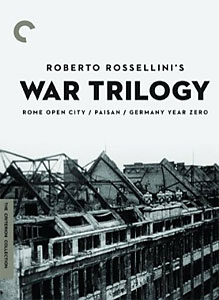
Roberto Rossellini’s War Trilogy
Recently I experienced Roberto Rossellini’s Rome, Open City for the first time, again.
A Vatican list film, Rossellini’s celebrated 1945 landmark of Italian neorealism is a must-see film for film lovers—and of course I saw it, and reviewed it, years ago. Even at the time, though, I knew I wasn’t really experiencing the film Rossellini made.
Partly this is because previous DVD and VHS versions of Open City were based on a print of the film with such spotty subtitles that they played as if the subtitler often got so absorbed in the story that he simply forgot for minutes at a time to keep up with the dialogue.
As a result, if you didn’t speak Italian, you missed over half of what was said … and if you did speak Italian, you were stuck with the distracting subtitles anyway, which were hard-printed onto the image and couldn’t be removed.
Now at last the Criterion Collection has come to the rescue with the Roberto Rossellini War Trilogy, a three-disc boxed edition that also includes Rossellini’s Paisan (1946) and Germany Year Zero (1948).
What I didn’t know until I rewatched the film in the Criterion edition was the extent to which I hadn’t seen the film before. I did know that Rossellini’s team had to scrounge for whatever film stock they could find to shoot the film, which contributed to the gritty, grainy imperfection of the images. However, the degradation of the images was greatly compounded by the worn, dirty condition of the prints used in the previous editions. For anyone who has seen the previous versions, the clarity and beauty of the new Criterion editions is stunning.
As important as Rome, Open City is cinematically, the 1995 Vatican film list includes the film not for its artistic significance, but for its moral value (it’s listed among the 15 films in the Values category). Rossellini’s film offers searing images of evil in the Nazis’ racist reign of terror, and celebrates the human solidarity binding together ordinary citizens, Communist activists, Catholic priests and even children in surreptitious resistance to Nazi oppression.
Open City is notable for its Catholic milieu, embodied in the heroic priest Don Pietro Pellegrini (Aldo Fabrizi), whose clerical status allows him to ignore curfews and even enter a building evacuated by the Nazis. Rossellini was not a faithful Catholic by any means, but his Catholic heritage was a significant factor in his work, most obviously in films like The Flowers of St. Francis and The Messiah. (The Flowers of St. Francis is also available in a must-have Criterion edition; The Messiah isn’t available on North American DVD, though you can dig it up on VHS used.)
I hadn’t seen Paisan or Germany Year Zero before, so the Rossellini War Trilogy is a fantastic opportunity to become more familiar with one of the most important filmmakers of the 20th century.
Recent
- American Martyr: An Oklahoma priest’s unlikely bond with persecuted Mayans in war-torn Guatemala
- Father Stanley Rother’s gift of presence: Interview with María Ruiz Scaperlanda
- The Odyssey and the consequences of war
- Why Doctor Strange is the best MCU movie: 10 reasons
- Aliens, humanity, and God: In Disclosure Day, Spielberg still wants to believe
Home Video
Copyright © 2000– Steven D. Greydanus. All rights reserved.