Dumbo (1941)
Somebody has to say it: Made at the height of Disney’s early brilliance alongside Snow White and the Seven Dwarfs, Fantasia, Pinocchio, and Bambi, Dumbo is the odd weak link in the chain.
True, the surreal “Pink Elephants on Parade” sequence is justly celebrated, and the title character — unique among Disney heroes for his silence — is among the more expressive and charming early Disney heroes.
Yet as a film Dumbo is thin and unsatisfying, lacking the coming-of-age richness of Bambi, the visual artistry of Pinocchio or Fantasia, and the thematic heft of Snow White.

Caveat Spectator
Comic accidental inebriation; mildly ominous imagery; tragic themes.At a mere 64 minutes, Dumbo seems padded to barely feature length, stitched together from unrelated material better suited to individual cartoon shorts, including a string of early songs (“Look Out for Mr. Stork,” “Casey Junior” [which morphs into “Little Engine that Could”], “Circus Parade,” and the best of the lot, the rowdy “Song of the Roustabouts”). Viewed in isolation, Dumbo has always felt to me like a practice feature film from animators whose only previous experience was short subjects.
That’s how Dumbo has always struck me — and it turns out it’s not far from the truth. Dumbo really was originally developed as a short film, but was promoted to a feature after the triumph of Snow White was followed by the financial disappointments of Fantasia and Pinocchio.
Dumbo was deliberately made on the cheap, without the lavish background work or lush animation styles of its peers. Compare the cartoony elephant anatomy of Dumbo, Mrs. Jumbo and the other elephants with the anatomical realism of Bambi, his mother and the other deer. There’s nothing wrong with the animation in Dumbo; it’s proficient and at times it’s quite lovely, but it’s not distinguished by the superior artistry of its peers.
Where the other early Disney features were the work of a new generation of animators who would later be known as Disney’s Nine Old Men, Dumbo was a last hurrah for the old guard, animators whose pioneering work on Disney’s Silly Symphonies had helped to develop animation as an art form, and who paved the way for the feature animation period, but didn’t really belong to that period. (After Dumbo, many of them retired.)
Dumbo’s fans celebrate its emotional power as the secret of its success, and it’s true that Dumbo has an emotional directness surpassing even Pinocchio and Bambi — a feat even more remarkable in light of Dumbo’s wordlessness. Yet Dumbo is also the feature in which Uncle Walt plucks the heartstrings most shamelessly, and the cruelty and pathos of the film extends for far too long, with too little catharsis at the end.
After all the other animal mothers already have their babies, lonely, homely Mrs. Jumbo’s bundle of joy is finally delivered by a late Mr. Stork (Sterling Holloway). (There’s an odd disconnect between the onscreen maternal joy of all the mothers with their babies and the vaguely fatalistic lyrics of “Look Out for Mr. Stork,” which seem to imply a wish to avoid the stork.)
Then comes the shock and shame of the enormous ears. Mrs. Jumbo and her fellow circus pachyderms, with their small ears, are clearly Indian elephants, but Mr. Jumbo, wherever he is (little Dumbo is initially named Jumbo Jr. after his presumptive father, but neither he nor any other bull elephants are in evidence anywhere), would seem to be a large-eared African elephant, and even that wouldn’t fully explain Dumbo’s unusual pinnal condition.
Dumbo’s ears not only earn him derision and ridicule from Mrs. Jumbo’s catty, stuck-up fellow elephant cows, they also make him the object of unwelcome attention from young circus spectators, ultimately leading, in a maudlin plot twist crueler than the death of Bambi’s mother, to Dumbo’s separation from his protective mother, who is slapped into solitary confinement in a circus trailer as a “mad elephant.”
At least Bambi’s mother only died, and Bambi was allowed to grieve offscreen in a two-year flash-forward as he was raised by his father. And he didn’t have to deal with feeling that it was his fault. Dumbo, by contrast, is left alone, or rather left to the company of Timothy Q. Mouse (Edward Brophy), a relation of Jiminy Cricket and every other diminutive Disney sidekick (if more engaging than most, possibly even Jiminy himself). Still, in all the annals of Disney animation, is there any tearjerking more unblushing than the sequence in which the chained Mrs. Jumbo reaches her trunk through the bars of her cage to nuzzle and rock her son?
And it doesn’t end there. After failure as a performing elephant, Dumbo endures a frightening, bewildering stint as a clown and further rejection by the herd (“From now on, he is no longer an elephant”) before getting accidentally inebriated, ironically unleashing his unknown strength.
Dumbo’s inebriation also unleashes the animators’s strengths as the film breaks into the astounding, surreal animation of “Pink Elephants” number.
Here, for a few minutes, Dumbo rises to brilliance: Fluid, morphing, sometimes outright menacing elephant shapes, at times rendered in dramatic neon pink and yellow highlights, squash and stretch back and forth, up and down, the mood changing with the music in a manner suggestive of Fantasia’s “Nutcracker Suite” sequence. Not until the Aladdin animators tried to keep up with Robin Williams’s manic Genie in “Friend Like Me” would post-war Disney approach the formal creativity of “Pink Elephants.”
This is followed up by the jumping “When I See an Elephant Fly,” a racially awkward minstrel-show sequence with jive-talking black crows that’s musically maybe the best moment in the film. The film goes out on a high note, but little Dumbo’s revenge on the elephantine shrews and his reunion with his mother in the final seconds of the film are too little, too late. Dumbo is a victim of short-film thinking in a format that needs something more.
Newly available in a 2-disc 70th Anniversary Blu-ray/DVD edition, Dumbo comes with a host of extras, of which the most interesting to me are a half-hour making-of documentary, “Taking Flight: The Making of Dumbo,” that puts Dumbo in historical context, and a Cine-Explore Picture-in-Picture tour of the film featuring Up director Pete Docter, Disney historian Paula Sigman and animator Andreas Deja that’s more interesting by half, in my opinion, than the film itself.
Archivists discovered sketches for a pair of deleted scenes starring Timothy Q. Mouse. One is a bizarre prehistoric fantasy in which dinosaur-sized mice terrorize helpless elephants, thereby explaining the elephant’s proverbial fear of mice; the other is a charming musical number called “Are You a Man or a Mouse?” (Dumbo, of course, is neither.) A couple of bonus Silly Symphonies show some early groundwork laid for the likes of Dumbo: “Elmer Elephant” tells the tale of a young elephant mercilessly teased by the other animals because of his long trunk, while “The Flying Mouse” is a strange fantasy about a mouse who longs to fly and is granted bat-like wings by a Pinocchio-style Blue Fairy!
Other extras include a 15-minute tribute to Dumbo featuring Roy E. Disney and animation historian Leonard Maltin, among others; some games for kids; a bunch of trailers and previews; and a one-minute made-for-TV introduction to the film by Uncle Walt himself.
Related
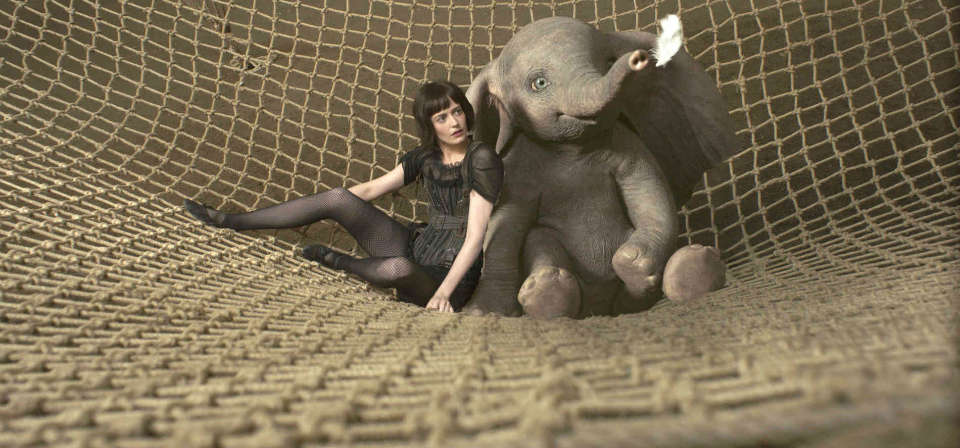
Dumbo (2019)
The Disney nostalgia train rumbles on with Tim Burton back at the throttle — not quite throttling the iconic tale of the flying baby elephant, but only barely rising to the challenge, sort of like Casey Junior struggling to clear that daunting hill.
Recent
- The Odyssey and the consequences of war
- Why Doctor Strange is the best MCU movie: 10 reasons
- Aliens, humanity, and God: In Disclosure Day, Spielberg still wants to believe
- Babe meets Knives Out in delightful, well-made The Sheep Detectives
- Hungering for a sense of grace: Interview with Wake Up Dead Man writer-director Rian Johnson
Home Video
Copyright © 2000– Steven D. Greydanus. All rights reserved.